Material for reading "Awareness of gender-based vertical and horizontal segregation in the labour market"
1.1 The factors influencing the gender based vertical and horizontal segregation in the labour market
Gender-based vertical and horizontal segregation in the labour market refers to gender labour inequities and the unequal distribution of female and male workers across and within job types. Segregation can be horizontal, with differences in the educational or occupational breakdown by gender with women and men concentrating in different fields, sectors, industries, occupations; and vertical, with noticeable gender inequalities present across different positions, job-status, responsibilities, and desirable attributes such as income and prestige.
Gender disparities in workforce participation emerge in and spread out across various levels. In this context, disparities might be observed at the individual level (e.g., personal motivation and achievements), the organisational/institutional level (i.e., teaching practices, curriculum, organisational gender culture), and the societal or national level. In addition, there is a broad variety of factors that contribute to the emergence and continuation of these disparities. As explained below, these factors are largely based on pre-existing social norms and stereotypes which, in turn, have created gendered divisions in the fields of education and labour. In this sense, occupational segregation is determined by people selecting and self-selecting their career path based on persistent occupational stereotypes.
For instance, gendered understandings of education have nurtured long-standing stereotypes about which kind of taught subjects are relevant or appropriate for male students and which for females. This type of educational sorting affects occupational choices as it often results in women choosing less ambitious employment paths. For example, the choice of study fields appears to be highly influenced by teachers and parents, self-efficacy and competence in individuals’ career choice decisions; students’ interests are driven towards specific subjects that are deemed ‘appropriate’ based on what the culture accepts. For example, girls do not seem to choose the subjects of Science and Mathematics while being at school, and thus there are not enough women choosing technology and science-related careers.
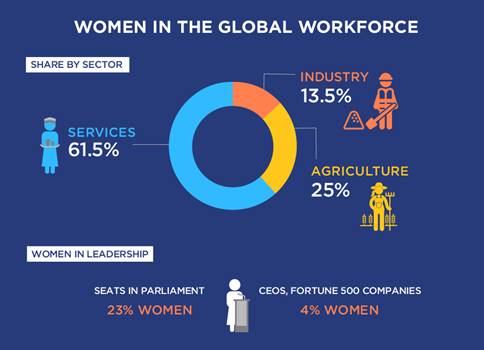
Source: https://interactive.unwomen.org/multimedia/infographic/changingworldofwork/en/index.html

Links for the self-learning
1.2 The statistical data in EU and own country related with gender segregation in the labour market
Segregation appears in both developed and developing countries. A sign of a gender-equal labour market should be that both men and women are closely active participants in the labour market. However, in all member states and in most candidate countries to become member states of the European Union, employment and participation rates for women, even if increasing in the last decades, are still systematically lower than for men. For example, the share of female ministers in EU is 29,5% women while the percentage for men is 70,5%. Also, the proportion of seats held by women in the European parliament is 30,3 % and 69,7% men. There are 41% of women in the European Parliament. On the other hand, the presence of women on the boards of the largest publicly quoted companies has greatly increased with the application of binding measures by some Member States and now is 29%.

At the same time, the degree of gender discrimination is high in various occupational sectors. Sectorial segregation is measured through the participation of women and men in specific sectors. For example, the sectors of education, human health and social work activities. Looking at the employment gap in these fields in Europe 30,5% of women and only 8,3 % of men are employed (EIGE, 2020).
However, patterns of gender-based employment segregation vary widely across countries and regions and are based on different levels and trends at country level. Thus, a better understanding of gender segregation, as well as its effects and underlying causes depends very much on the specific country’s policies, economic conditions, and gender social norms.
“The gender segregation of some occupations came into particular focus during the COVID-19 crisis. Some stands of work were classified as essential during the pandemic, which often exposed these workers to unprecedented workloads, health risks and work-life balance challenges. Around 7% of workers reported a large increase in their working hours during the pandemic. These included health professionals, of whom 72,5% are women in the EU. Women dominate some occupations, especially those often characterised by lower salaries. For example, women account for more than 85% of nursing and midwifery professionals and personal care workers in health services. Another example of a low-paid, female-dominated occupation that became essential during the crisis is food store cashier; these workers faced similar challenges to their health and work-life balance.”
Source: https://gender-spear.eu/assets/content/EIGE%20Index%202020.pdf

Links for the self-learning
Gender statistics: Labour Market
1.3 The broader social context, related to the segregation in the labour market
- For women, the difficulty of combining work and family could also explain occupational segregation. The fact that mostly women are responsible for the majority of domestic chores contributes to employment segregation by making women select positions or fields of occupation that allow predictable work schedules and flexibility. In particular, women choose jobs that maximize their ability to combine paid work and family responsibilities, and this leads to limited job options, limited mobility opportunities, accepting repetitive tasks, low salaries and lack of chance to acquire more skills. Thus, the intra-household allocation of time is highly affected by gender norms on the division of domestic responsibilities, and they predetermine women’s participation in particular categories of occupational structure. It is important to highlight that these factors may be mitigated by the influence of state intervention with policies such as equal opportunities policies, anti-discriminatory policies, policies to enable balancing career and family life.
- In the EU more women (38%) take care of children, grandchildren, older people and/or people with disabilities every day for 1 hour or more compared to men (25%). The COVID-19 pandemic has increased pressure on families, especially women and lone mothers.
- Another factor affecting employment choices is the effect of presence or absence of a role model. Role models impact prescribed gender roles and stereotypes, and women’s expectations of their ability to succeed in a field.
- In the labour market, particular occupations have come to be associated with one or other sex. This stereotypical interpretation of occupations affects the job choices of women, the hiring process, their income, the evaluation, recognition of the specific skills required by a particular job and the work assignment. Therefore, as mentioned by EGGE, stereotypes work as “mechanisms of segregation with the progressive demolition of the formal barriers preventing women from entering specific occupations”.

Links for the self-learning
Social Norms and the Labor Market