Material for reading "Using non-discriminatory language in work with female learners"
5.1 Understanding the importance of using non-discriminatory language within the learning process and using inclusive language, between the educator and the learners and between the learners themselves
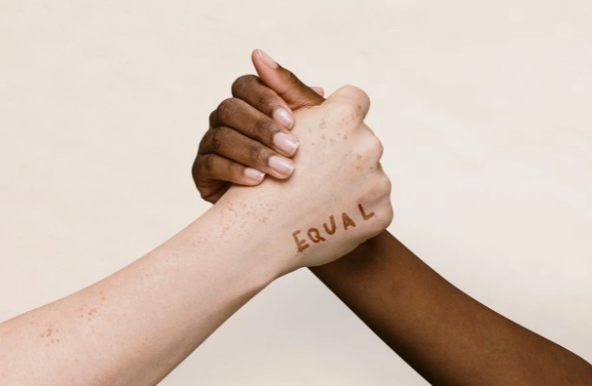 When learning a group of learners, it is always important to put a focus on language, as this has a clear and important impact on them. Non-discriminatory language gathers from gender-inclusive language, to avoid derogatory terms when referring to other ethnicities and races, or to people with diverse sexual orientations. First, it is important for the educator to get used to the terms. When we speak about diversity in the context of equality, we refer to the process of identifying and respecting both individual and group differences (Queensborough Community College, 2020). It is a term that encompasses both acceptance and respect for differences.
In regard to race and ethnicity, it is important for the educator to understand the concept of stereotypes, in order to avoid falling into some of them, which may be offensive for the group of learners. As Nittle (2020) describes, “stereotypes are characteristics imposed upon groups of people because of their race, nationality, and sexual orientation”. However, we can also include gender, because there are several stereotypes that are assigned to men and women distinctively. All of these characteristics usually are oversimplifications that do not represent the reality of the majority of the individuals from the group; and they tend to be filled with negative connotations. It is important for the adult educator to keep in mind that using and believing stereotypes will make them ignore the differences between the individuals within the group (Nittle 2020); and that apart from feeling offended by some of these stereotypes, some of the learners may feel ignored and not taken into account during the process, which may lead to their discouragement and failure. Thus, the adult educator should stay as far away as possible from these social constructions in order to avoid harming the trust and friendly relationship they have built with the learners during the learning process. Some examples of stereotypes, specifically of gender stereotypes, include gender-based language that either implicitly or explicitly favours one gender over another, generally the male gender (“women do not know how to drive”, “women are not suited for business, their main task is to take care of the children”, “the actor and his wife”, etc.).
Another aspect for the educator to take into consideration is that respect is a two-way street, so if the adult educator does not show respect for the learners and approach them in an appropriate manner, the learners will most likely do the same. If the educator treats the adult learners with respect and taking into account their feelings, the learners will feel valued and respond accordingly (Price-Mitchell, 2014). Thus, in order to be able to build the respect relationship among the educator and the learners, the educator has to implement several strategies (Price-Mitchell, 2014):
● Words of encouragement: instead of highlighting where the learners went wrong, the educator should focus on the positive aspects of their learning process. Learning from mistakes is important and very useful, but these cannot take up all the space, otherwise the learners will feel discouraged and will probably stop trying to re-train themselves.
● Words of grace: again, instead of blaming the learners for their current situation, the educator should guide them to better places with care, making them aware of their failures but letting them know that these are normal and that they can be amended.
● Words of guidance: the role of the educator as a guide in their process is essential, as many of the female learners will feel out of place, and they will probably be dealing with new terms and topics that may make them feel afraid at first. It is important for the educator to be present during their process and showing that help is available if the learners ever need it.
● Words of unity: another way to build respect within the group is building the group. This means that the educator recognises everyone in the group and no one is left behind, building relationships not only between the learners and the educator, but also between learners themselves.
Linked to this last point, it is also important for the educator to remind learners that all those features that apply to the language, communication style and way of behaving of the educator, also apply to the interactions the learners have between each other. It is crucial for the members of the group to address each other respectfully, avoiding all types of offensive behaviours or terms, in order to ensure the proper development of the learning process of all those involved.
5.2 Dealing with disadvantaged female learners in full respect
Engagement in adult learning can be challenging for learners, because they are constricted to more strict time schedules and responsibilities than younger learners. Sometimes their learning process is hindered by not having the enough resources to properly involve themselves in such training, or they do not have the time to do so (Madzarevic, 2017). The educator has to be aware of the personal situation of the learners, and try to support them and adapt the training to their needs as much as possible, facilitating their engagement and their learning process. Also, some psychological constraints may be present in these learners, like the wrong belief that it is already too late for them to start learning something new, or that it will not change much in their current situation. They may also feel afraid of making mistakes, or even to acknowledge that they do not have the enough competences to carry out the training in the same way as the other participants (Madzarevic, 2017). In order to overcome these situations, it is very important for the educator to motivate the learners and reassure them during the process, making sure that they have enough confidence in the adult educator to ask for help when they feel lost. It is essential to highlight that learning and achieving new competences have an intrinsic value, not only in order to access new jobs, but also it can help learners improve other aspects of their lives (Madzarevic, 2017).
 In a similar path, Carter (2019) remarks that the educator has to consider some of the learners’ characteristics that may affect their process, as previous experiences that may subject their present process due to prejudices. The fact that adults have already been shaped by real life experiences affects their learning process, as they tend to be less flexible during the process, when presented with different approaches for example. Thus, it is the task of the educator to be flexible and try to talk them into trying new methodologies, adjusting those to the learners’ needs and special characteristics. Carter (2019) also highlights that one of the challenges for the adult educator is how to support the learners’ social and personal needs while also taking care of their professional ones. He states that one of the challenges and at the same time the main solution to this question is ICT. ICT tends to be a space where many adults do not feel secure, because they are not used to them except for having a smartphone and working at user level with a computer. However, improving their ICT competences, can allow them to balance their personal commitments to their learning process, as many of the training sessions can now be shifted to online formats.
 Link for the self-learning
Challenges for Adult Education. It is well known that we live in an age… | by Daniel John Carter | Age of Awareness | Medium