Material for reading "Understanding the ways to reduce gender pay gap in the labour market"
2.1 Defining gender pay gap
The gender pay gap could be described as ‘a measurable indicator of inequality between women and men’ (International Labour Organisation). More specifically, the gender pay gap measures the difference in average gross hourly earnings between women and men.
Women’s employment rate in the EU is higher today than ever before but:
- Women are underrepresented in the labour market, either because of their gender, conditions of vulnerability or marginalisation due to their ethnicity, religion or migrant background;
- Wider pension gap shows that older women are more at risk of poverty than men;
- Lack of transparency shows that many women do not know or cannot prove they are underpaid.
 Links for the self-learning
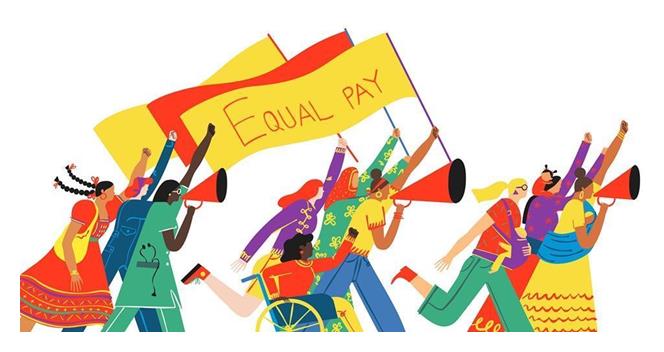
Explainer: Everything you need to know about pushing for equal pay
The gender pay gap situation in the EU
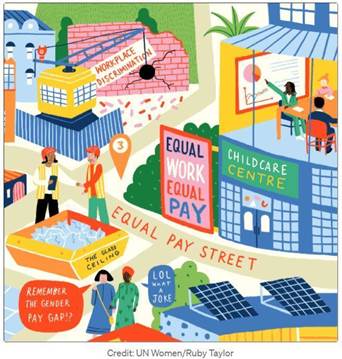
Source: https://www.unwomen.org/en/news/stories/2020/9/explainer-everything-you-need-to-know-about-equal-pay
2.2 The statistical data proving gender pay gap in EU
A recent EIGE study (2017) shows that wage payment is the category in which the largest gender difference can be observed. Among employees, almost every fifth woman and every twelfth man receive very low wages. Across the EU, the pay gap differs significantly (European Parliament, 2020), with the highest percentiles being observed in Estonia (25.6%), the Czech Republic (21.1%), Germany (21%), UK (20.8%), Austria (19.9%) and Slovakia (19.8%) in 2017. In contrast, the lowest gaps are found to be in Slovenia (8%), Poland (7.2%), Belgium (6%), Italy and Luxembourg (5% each) and Romania (3.5%). The pay gap in the EU is 14,8%.
 Links for the self-learning
2.3 The complexity of the factors influencing pay gap and the negative influence of gender-based segregation in the labour market on the pay gap
Equal pay refers to the right to receive equal remuneration for work of equal value. Even if the concept is straightforward, the ways that equal pay is applied in practice has proven to be difficult and thus one of the major impacts of occupational segregation. The gender pay gap is a complex issue with many factors contributing to this inequality. Differences in average pay for men and women arise for various reasons, which are often interrelated.
- Lack of female supervisory and managerial schemes is a the contributory factor that brings down the average salary of female managers compared to that of male managers. Eurostat data (2017) shows that women hold fewer positions in more strategic roles, and they earn 23% less per hour than male managers.
- The second factor to consider is workplace flexibility. This is often linked with the fact that certain professions and organizations demand more working hours or particular working hours. This leads women to make different decisions when it comes to their working hours. Marital status, parenthood and household work explain this difference in decisions. More particularly, gender stereotypes and societal expectations force women to apply for family-friendly jobs in order to maintain a balance between work and household, and family responsibilities. According to a report from Schieder and Gould, focusing on how discrimination, societal norms, and other forces affect women’s occupational choices—and their pay, “the long hours required by the highest-paid occupations”, and “the need to balance work with family commitments, and the availability of flexible working practices may restrict individuals’ employment options”, and this is therefore affecting their earnings. At the same time, employers’ preferences also appear to be driven by gender-specific stereotypes.
- Such stereotypes can also occur in education. Traditions, social norms and stereotypes may influence the choice of educational paths and employment patterns. Research shows that school career and personal education goals are affected by gender stereotypes and school career services, which often encourage girls and boys into traditionally gendered occupations. The Gender Equality Strategy 2020 – 2025 published by the EU Commission also focuses extensively on the elimination of gender stereotypes & the gender gap in the STEM field. The report addresses the gender stereotypes that impede women’s participation in STEM professions, quoting that despite the fact that girls outperform boys in digital literacy, women represent 17% of people in ICT studies and careers in the EU and only 36% of STEM graduates, calling for concrete actions that address the horizontal segregation, stereotyping and gender gaps in education and training.
- Another likely driver of the gender pay gap across the labour market is that the latter varies widely by type of occupation; women numbers are more concentrated than men in occupational sectors which pay less, such as in education, health and social work. This female under-representation is often referred to as occupational segregation and is linked to the predominant male presence in specific professions such as science, technology, engineering and mathematics. According to EIGE’s Gender Equality Index 2020 for Cyprus, eight times more men (25%) than women (3%) work in STEM occupations; of the total ICT specialists, just 18% are women as opposed to 82% men! In Lithuania, men dominate study fields such as computing (87.5%) and engineering (83.1%), while women hold the majority of degrees in social services (81.6%) and health care (74.7%). This trend is similar in other EU countries. This means that statistically, boys and men tend to go to higher-paid occupations in STEM, in contrast to women.
- In addition to the low female participation in high-earning sectors there is also a considerable degree of vertical and horizontal occupational segregation by gender within the sector. In the recent research report, Tackling the technology gender gap, produced by the Tech Partnership, it is stated that “men and women are equally likely to be in professional occupations, but men are more likely to hold managerial or skilled trade roles”. Moreover, jobs that require the same skills, qualifications or experience tend to be poorly paid when they are performed mostly by women instead of men.
 Links for the self-learning
2.4 The pay gap within the digital sector
#EqualPay has been one of the headline-grabbing hashtags in 2019, highlighting the issues women face towards achieving parity with men. Gender inequality in certain sectors is striking, most notably in the digital industry. The lack of access in the digital sector and thus the low presence of females in key areas of the digital labour world as well as invisible and unpaid work maintain and aggravate the pay gap issue within the digital sector. Thus, “despite fairly widespread acceptance of the notion of gender pay discrimination, there are many legislative and non-legislative measures that need to be adopted aiming to proper enforcement of the equal pay principle”. In conclusion, the pay gap within the digital sector is reinforced by discriminatory social norms, the legislative framework and lack of wage transparency.
2.5 The impact of pay gap on women’s pensions and poverty
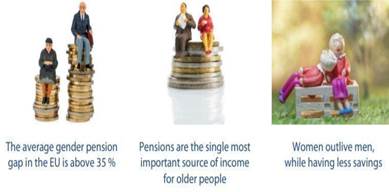
The issue of the gender pay gap needs to be considered in the context of overall gender inequality which affects women’s quality of life and carries on after their employment age. According to a report on equality between women and men in the EU (2018), gender gaps in terms of employment, translate into a significant gap in pensions at retirement and is one of the significant causes of poverty in later life for women. To conclude, the earning gap has a sequel which is the pensions gap, with statistics showing in 2018, women in the EU aged over 65 received a the pension that was on average 30% lower than that of men and consequently, the proportion of female pensioners aged over 65 who were at risk of poverty was around 3 to 4 percentage points higher than the rate for male pensioners.
 Links for the
self-learning
Links for the
self-learning
Differing expectations of older men and women in the workplace
Today’s gender pay gap is tomorrow’s pension gap
2.6 Narrowing the Pay Gap – How can we achieve it?
Tackling the gender pay gap and improving gender equality can be achieved by:
- Setting gender equality as a horizontal priority for the entire MFF.
- Addressing all of the pay gap’s root causes.
- Transforming roles and responsibilities in care work and promoting work-life balance in the EU
- Increasing the participation of women in the labour market.
- Promoting equal sharing of caring responsibilities and childcare between men and women.
- Improving gender balance in traditionally male or female-dominated professions.
- Addressing gender stereotypes.
- Making sure that women and men receive equal pay for the same work and for work of equal value.
- Tabling binding measures on pay transparency.
- Promoting equal uptake of family leaves and flexible working arrangements thus improving access to high quality and affordable childcare and other care services.

Links for the self-learning
#EqualPay: The gender gap in the tech industry (Women’s Day special)